Tandem Villages advances a permanent supportive-housing village and a market-oriented cottage community in parallel—sharing knowledge and momentum while preserving separate ownership, financing and accountability.
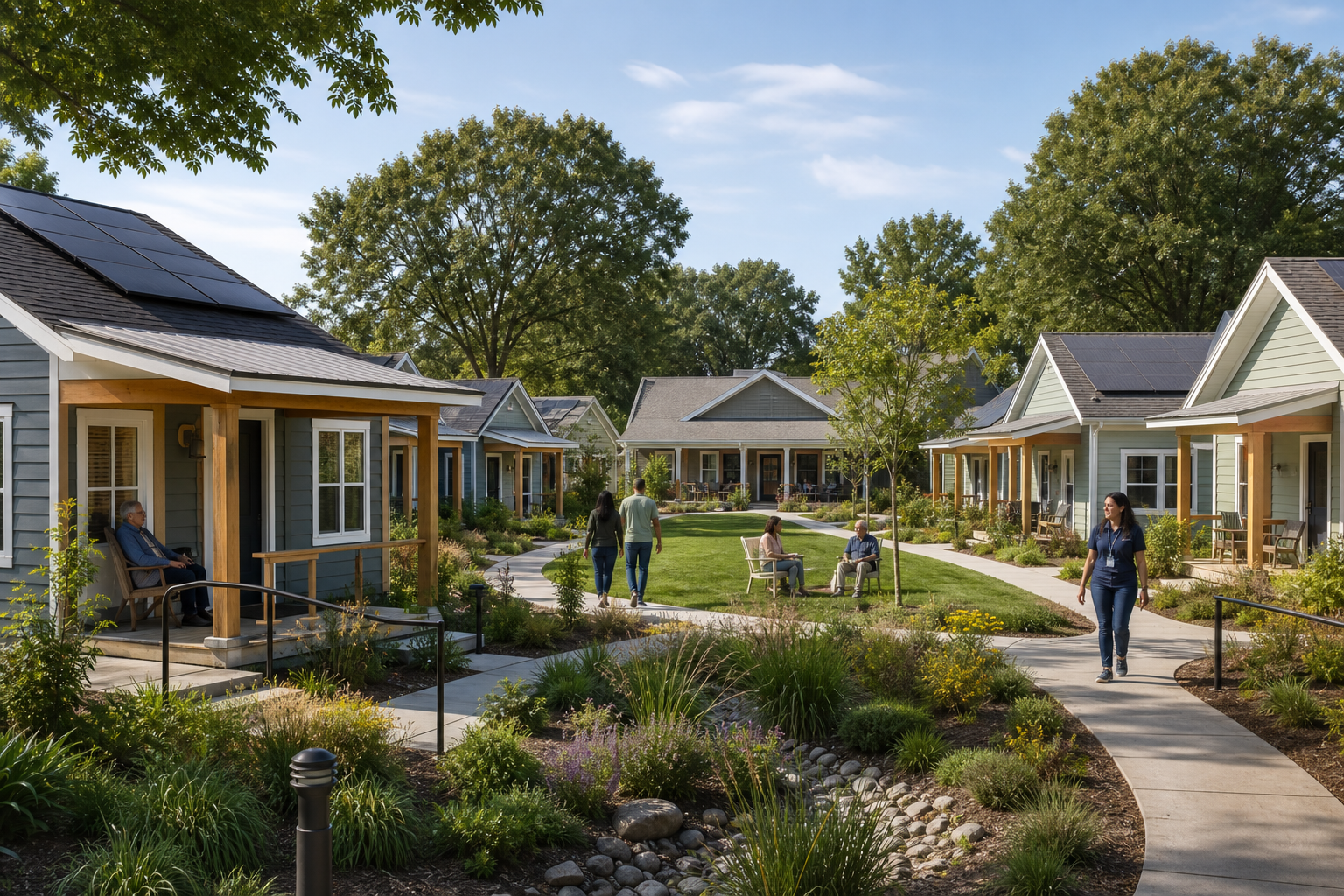
AI-assisted planning visualizations · the 4.5-acre Cottages plan and written program govern · final designs subject to review
One county. A wider housing continuum.
Housing scarcity is not one problem, and it will not yield to one housing product.
Pathway Village addresses the need for permanent supportive housing. New Jersey Cottages explores smaller market and workforce-oriented homes. Together, they demonstrate how a single development platform can build different answers for different households.
Fifteen private, single-occupancy homes for adults who can live independently with coordinated support. Pathway is the nonprofit project and is further along in predevelopment.
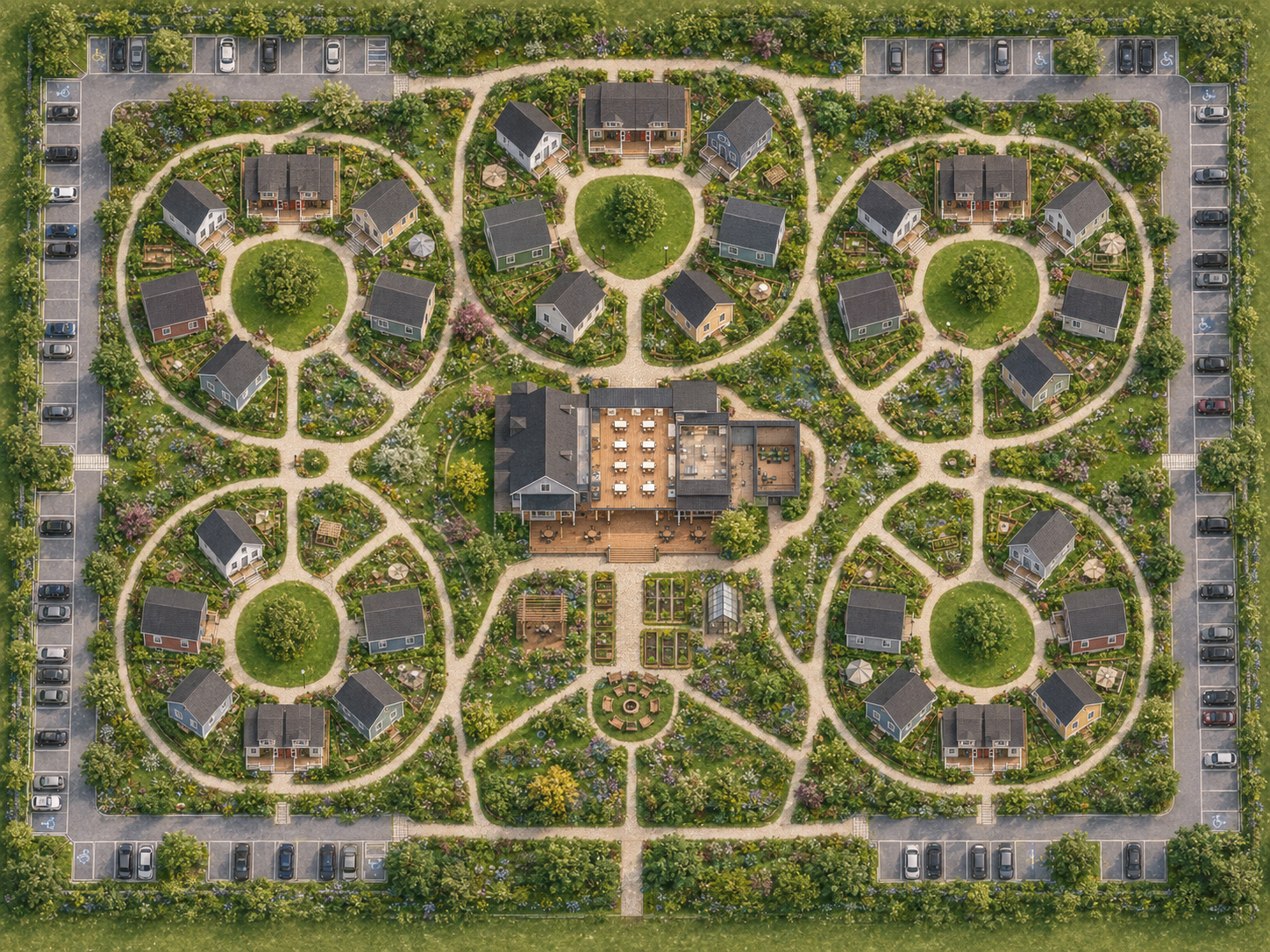
A 4.5-acre prototype for 40 cottage-scale homes of approximately 600–800 square feet at a future Burlington County site, led by private development and equity.
Market, workforce and possible affordable scenarios
Compact land and infrastructure strategy
Rental, ownership or phased structures to be tested
AI-assisted planning visualization. The 4.5-acre concept is illustrative and remains subject to site control, engineering, code review and municipal approvals.
A tangible compact-development test
The 4.5-acre prototype turns shared principles into a village framework.
Five clusters of eight homes surround a central pavilion, keeping the neighborhood walkable while giving every dwelling a porch and a private garden or patio.
Detached cottages, duplexes and selected two-story homes broaden choice and reduce building footprints.
Perimeter parking protects a pedestrian-first interior and keeps cars from defining the residential experience.
A central group hall, covered gathering area, laundry and equipment storage place shared functions where paths naturally meet.
Shared greens, visible porches and connected paths encourage routine contact without eliminating private space.
Separate ownership. Separate financing. Shared innovation.
Share what lowers cost
Design vocabulary, professional expertise, procurement knowledge, construction lessons, energy standards and property-management systems.
Ring-fence what protects trust
Legal entities, budgets, accounts, collateral, reporting, restricted funds, service obligations and underwriting remain project-specific.
Invite more partners
Agencies, municipalities, banks, CDFIs, foundations and private investors can participate only in the component that matches their mandate.
Why now
New Jersey policy is moving toward more housing, more coordination and more choice.
The Fourth Round runs from 2025–2035. The 2025 State Plan supports diverse housing types and compact development. Executive Order 17 directs agencies to coordinate housing production, financing and use of public land.
2025–2035Fourth Round municipal planning cycle200,000+State-reported housing shortage affecting low-, moderate- and middle-income householdsEO 17Whole-of-government direction to accelerate production and coordinate financing
Capital follows purpose
Coordination does not mean commingling.
Each capital source belongs only where its rules and underwriting permit. The tandem platform creates a common table while maintaining a documented firewall between nonprofit, affordable, workforce and market-rate uses.
Pathway capital
NJHMFA supportive-housing sources, DCA or local housing funds where eligible, bank or CDFI debt, philanthropy, rental assistance and separately funded services.
Cottages capital
Private construction debt, developer or impact equity, municipal land-use tools and eligible workforce or affordable programs only where the structure qualifies.
Shared discipline
Separate sources-and-uses, accounts, collateral, reporting, cost allocation and legal review.
The adopted plan calls for a full range of housing choices, compact development at appropriate densities and coordination of land use with infrastructure.
We are seeking agencies, municipalities, lenders, CDFIs, foundations, developers, service organizations and professional partners to refine the two-project strategy.